
Tamron 12–20mm F2.8 Review - The Whole World... And Then Some...
Sixteen millimeters is wide. Fourteen is seriously wide. But twelve millimeters on full frame?
That’s a different universe. The new Tamron 12–20mm F2.8 takes you there with a constant F2.8 aperture, a surprisingly compact body, and a level of control we haven’t seen from Tamron before.

Tamron 12–20mm F2.8. Product image: Tamron.
There are two types of photographers.
Normal photographers arrive at a beautiful location, enjoy the view, and take a few pictures like civilized human beings.
And then there are ultra-wide photographers.
They arrive at the same location, look at the same beautiful landscape, and immediately start rolling around in the mud, thinking: “Hmm… what if I put the camera ten centimeters away from this root and turn it into a massive leading line?”
Because wide-angle photography isn’t really about fitting as much as possible into the frame. That’s the beginner trap. It’s about getting closer. Finding foreground. Working with lines, playing with perspective, and building depth that makes a flat photograph feel three-dimensional.
The new 12–20mm is built primarily for that second group. On a full-frame sensor, this is more than just a slightly wider lens. It’s a different way of seeing. Perspective becomes more dramatic, distances seem to stretch, and anything you place close to the front element suddenly plays a much bigger role in the image.
But twelve millimeters won’t let you get away with much. Without a good foreground and a considered composition, you can easily end up photographing an enormous amount of empty space and a few suspiciously small mountains on the horizon.
And this time, there’s more going on than another addition to the lens lineup.
The A084 marks the beginning of a new chapter for Tamron. New design language, much more elaborate controls, and even a new naming system.
Over the years, I’ve occasionally struggled to keep a straight face while introducing Tamron lenses and working my way through Di III, VXD, and the rest of those vaguely Star Wars abbreviations. Thankfully, those are now disappearing from the name. What’s left is the part we actually needed to know: TAMRON 12–20mm F2.8.
But the simpler name and smarter exterior are just the first things you notice. Underneath, there’s a completely new optical formula, the biggest XGM element Tamron has ever used, internal zoom, more controls than you’ll know what to do with at first, and one of the most entertaining lenses I’ve tested in years.
This time, I took this ultra-wide beast to the Tatra Mountains. It belongs out in the field, and there’s no better way to find out what it can do than howling wind, nonstop rain, and approximately seventeen seconds to get a decent photograph.

Tamron 12–20mm F2.8 | 12mm | F8 | Focus stack of 5 images. Photo: Mike Stehlik.
Build and Ergonomics
One look tells you Tamron didn’t just change the font on the box. The 12–20mm F2.8 is the first lens to introduce its new design language, called “Toned Profile Next”. The smooth, rounded shapes are gone, replaced by a more angular, technical, and altogether more grown-up look.
Tamron’s marketing department describes it as “a mechanical style resonating with the preferences of modern users,” which is the kind of sentence I strongly suspect was born during a very long meeting. Translated into normal human language: it looks more modern, more professional, and a lot more interesting than the previous generation.
Despite those extreme twelve millimeters and a constant F2.8 aperture, this isn’t some enormous optical paperweight. The Sony E version measures 119.3mm and weighs 570 grams. The Nikon Z version adds two millimeters and fifteen grams. You’re not going to mistake it for a tiny 24mm prime, but considering what’s inside, the size is surprisingly manageable.
Up front, there’s a strongly curved XGM element protected by a built-in lens hood. At over 55mm across, it’s the biggest XGM element Tamron has ever used.
Advances in manufacturing made it possible to put an aspherical element that size right at the front, where it helps control distortion and astigmatism without turning the whole thing into an optical monster. Naturally, there’s no room for a conventional filter thread, so Tamron has built a sheet filter holder into the rear of the mount.

Optical construction showing the XGM, XLD, LD and molded glass aspherical elements.
The 12–20mm uses internal zoom, so the lens doesn’t grow as you change focal length, and its center of gravity barely shifts. Out in the field, there’s another benefit: turning the zoom ring doesn’t extend the barrel into the rain, dust, and whatever else is currently trying to get into your gear.
The body is also thoroughly sealed against moisture and dust, including the USB-C port.
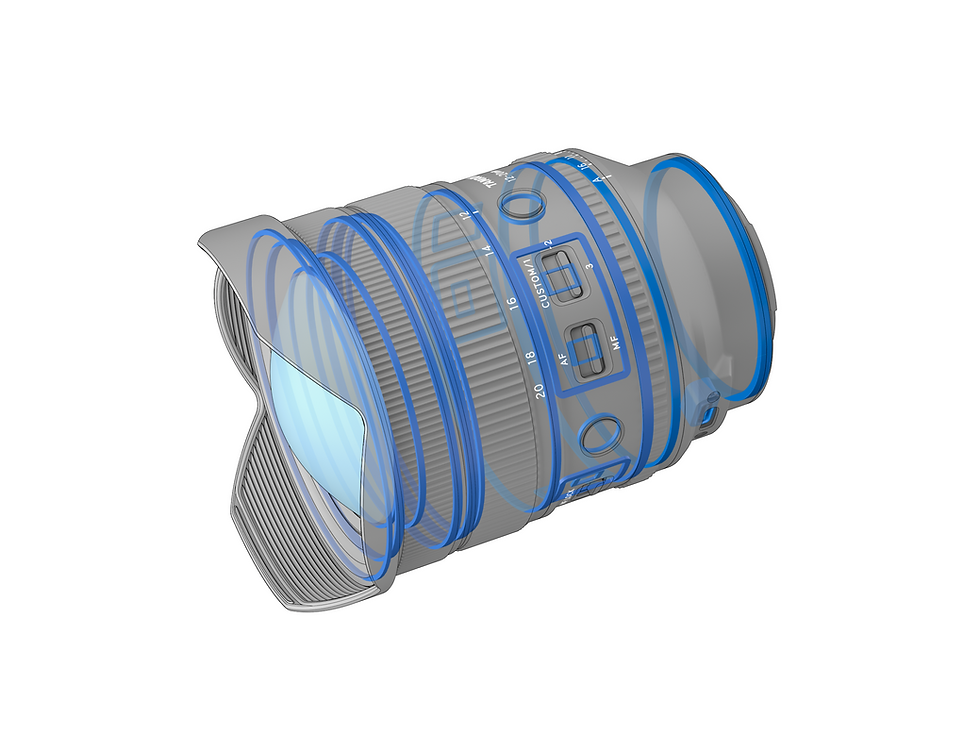
Sealing locations throughout the lens.
A New Generation of Controls
The controls have changed even more than the exterior. Tamron used to be fairly restrained here. With the 12–20mm, you briefly get the feeling you’ve bought a lens with the cockpit of a Boeing attached to it.
But that wears off quickly. The layout makes sense, the switches have a proper, confident click, and even shooting at night, I had no trouble finding exactly what I needed by feel.
Alongside the zoom and focus rings, there’s now a third ring. On Sony E, it controls the aperture directly. On Nikon Z, it’s a programmable control ring that you can assign to aperture, exposure compensation, or another supported function in the camera menu. Both versions have a Click ON/OFF switch, giving you tactile steps for stills or smooth, silent rotation for video.
Sony adds an Iris Lock, while Nikon puts a Control Lock in the same spot.
And it keeps going. There’s an AF/MF switch, two Focus Set buttons, a separate Custom Switch, and locks for both the focus ring and zoom.
The USB-C port connects the lens to Tamron Lens Utility or the TAMRON-LINK Bluetooth adapter (click for whole Tamron Link and Tamron Lens Utility review).

Controls at a glance, including the differences between the Sony E and Nikon Z versions.
Prefer watching to reading? Here’s the full video review.
Image Quality
With a full-frame lens that starts at twelve millimeters, holds F2.8 throughout the zoom range, and weighs just 570 grams, you expect the laws of physics to speak up at some point.
And of course they do.
Just a lot more quietly than you’d expect.
Because optically, this thing is seriously impressive.

MTF charts for 12mm and 20mm at F2.8.
At 12mm, the center is excellent even wide open. I mean, it’s really sharp. Move towards the edges, though, and things get a little more complicated.

12mm | F2.8 | Focused on the center — center detail.
When I focus in the center, the corners get noticeably softer… but they’re not simply “soft”…

12mm | F2.8 | Focused on the center — corner detail.
Because if I focus on the corner instead, suddenly there’s a lot more detail. But the center starts drifting away instead.

12mm | F2.8 | Focused on the corner — corner detail.

12mm | F2.8 | Focused on the corner — center detail.
What we’re looking at here is field curvature. The plane of focus simply isn’t perfectly flat.
And with this lens, that isn’t an accident. Tamron optimized it primarily for landscapes, astrophotography, and distant subjects. They even considered adding a floating focus mechanism, which could improve flat-field performance at closer distances. But that means more moving optical groups, more hardware, more size, and more weight…
So they deliberately left it out.
And honestly, for a lens like this, I think that trade makes a lot of sense.
Of course, if your main subject is a perfectly flat wall… yeah… you should know about it.
But in an actual landscape… where almost nothing sits on one perfectly flat plane anyway… I barely noticed it.

12mm | F2.8 | A real-world example.
Stop down and it gets easier… Around F8, the extra depth of field hides much of the difference, and the corners look very respectable.

12mm | F8 | Focused on the center — corner detail.
Maybe not optical-lab perfect… but we’re still talking about twelve millimeters on full frame.
Again… physics.
At 20mm, things get more even. The center at F2.8 is still very good, although slightly softer than at twelve. But the corners hold up better, and somewhere around F5.6 to F8, the whole frame looks really solid.

20mm | F2.8 | Focused on the center — center detail.

20mm | F2.8 | Focused on the center — corner detail.

20mm | F8 | Focused on the center — center detail.
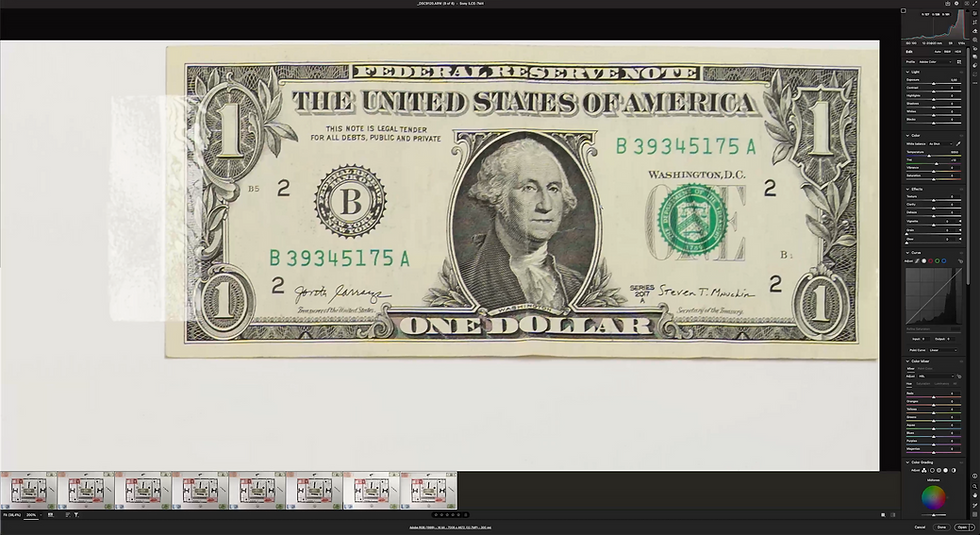
20mm | F8 | Focused on the center — corner detail.
So basically… 12mm gives you the stronger center. At 20mm, you get a more even frame.
And out in the field, both ends look excellent.
Distortion
And then there’s something ultra-wide lenses generally don’t enjoy talking about…
Straight lines.
At 12mm, with corrections turned off, there’s visible barrel distortion with a slightly more complex, almost mustache-shaped pattern towards the edges.

12mm | Barrel distortion with lens profile corrections off.
At 20mm, it flips to pincushion distortion. But it’s milder and even easier to correct.

20mm | Pincushion distortion with lens profile corrections off.
Lens profile corrections handle both very well. So yes, the distortion is there. But one click in Lightroom, and you can move on with your life.

12mm | The same shot with lens profile corrections on.
Vignetting
Vignetting is a little more obvious. Especially at 12mm and F2.8, the corners get properly dark.

12mm | F2.8 | Vignetting with lens profile corrections off.

20mm | F2.8 | Vignetting with lens profile corrections off.
Stop down and things improve straight away. At 20mm, the vignetting is noticeably milder. Again, lens profile corrections take care of most of it instantly.

12mm | F2.8 | Vignetting with lens profile corrections on.
For normal landscape photography, a little vignetting honestly doesn’t bother me.
Under the stars, it’s slightly different, because brightening dark corners also brings up noise.
But we’ll get to that in a minute.
Chromatic Aberration
If you deliberately want to make a lens produce ugly color fringing, tiny dark leaves against a bright sky are usually a pretty reliable way to catch it out.

20mm | F2.8 | Leaves against a bright sky in the chromatic aberration test.
Except there really isn’t much here.
Sure, you’ll find a little if you really go looking, but chromatic aberration is otherwise very well controlled. No big purple or green outlines. Nothing to worry about.

20mm | F2.8 | Leaf-edge detail from the same shot.
Flare and Sunstars
And since apparently we haven’t annoyed the laws of physics enough yet, let’s see what happens when we point that XGM element directly at the sun.
This was another pleasant surprise.
Flare resistance is really good, contrast holds up, and ghosting is well controlled.

12mm | F2.8 | Shooting directly into the light.
And yes, if I find exactly the right angle, I can make a few artifacts appear. This is still an ultra-wide lens with a huge curved front element…

Flare detail at a particular angle to the sun.
But overall, it behaves remarkably well.
Tamron is using AX Coating together with BBAR-G2. Whatever they’re doing with those coatings, it works…

Stop down and the twelve-blade aperture also produces clean twelve-point sunstars.

12mm | F16 | Sunstar
Are sunstars the reason you buy a professional ultra-wide zoom? Probably not… But if you like them, these are pretty lovely…
Close Focusing
This is probably my favorite feature of the whole lens.
Minimum focusing distance at 12mm is eighteen centimeters. And that’s measured from the sensor. From the front element, I’m roughly five centimeters away.
Five!
And this is where twelve millimeters gets ridiculously good. Thanks to perspective distortion, even a tiny flower can completely own the foreground while an entire mountain range still sits behind it.

Tamron 12–20mm F2.8 | 12mm | Focus stack of 4 images. Photo: Mike Stehlik.
I honestly can’t remember the last time I had this much fun with a lens.
Autofocus
Autofocus is handled by Tamron’s VXD linear motor. Ultra-fast, ultra-accurate, and ultra-quiet.
Yes, in landscape photography, the mountain generally isn’t trying to escape. So it’s hardly the toughest test of autofocus speed…
But even in low light, it locks confidently. And for video, transitions are beautifully smooth, with very little focus breathing.
A Little Astro…
Under the stars, this lens might impress you even more…
Twelve millimeters. F2.8… a little astro dream…

Tamron 12–20mm F2.8 | 12mm | Blend of 3 exposures — 2 at F8 for the foreground and 1 at F2.8 for the starry sky. Photo: Mike Stehlik.
With most fast ultra-wide lenses, stars near the edges start turning into tiny “seagulls”.
Here, coma is incredibly well controlled. The stars stay clean and nicely round almost all the way into the extreme corners.

12mm | Detail of the starry sky.
There’s just a tiny bit of stretching right at the very edge. But this is an excellent result.

12mm | Star detail at the extreme edge of the frame.
And yes, the vignetting is still there. Correcting it can bring a little more noise into the corners, but I usually darken those parts of the sky in post anyway. So in practice, it really hasn’t bothered me.
When you add the enormous field of view, F2.8, the focus lock (you focus on the stars, lock the focus, and can then handle the camera without constantly worrying that you’ll accidentally knock the focus off infinity in complete darkness), and a body you’ll actually be willing to carry into the mountains, this is one of the best (if not the best) ultra-wide zooms on the market for astrophotography.
But the greatest magic of this lens isn’t in the number of cool switches or the autofocus speed. It’s in those twelve millimeters.
You notice the difference between 16 and 14mm immediately. But moving from 14 to 12mm isn’t just another small step. When working with a very close foreground, the perspective changes so much that you start looking for a scene in a completely different way. Instead of stepping back, you move closer. Instead of asking how much of the landscape you can fit into the frame, you’re thinking about what you can get right up to the front element.
This is where the 12–20mm becomes incredibly addictive.
Tamron 12–20mm F2.8 — Key Specifications
Model: A084 (A084S / A084Z)
Focal length: 12–20mm
Maximum aperture: F2.8
Optical construction: 17 elements in 12 groups
Aperture blades: 12
Minimum focusing distance: 0.18m at 12mm / 0.28m at 20mm
Maximum magnification: 1:5.8 / 1:9.1
Filters: No conventional filter thread; integrated rear sheet filter holder
Optical stabilization: No
Weight: 570g (Sony E), 585g (Nikon Z)
Length: 119.3mm (Sony E), 121.3mm (Nikon Z)
Protection: Moisture- and dust-resistant construction; fluorine coating on the front element
TAMRON Lens Utility compatibility: Firmware updates and lens function customization
Verdict
The Tamron 12–20mm F2.8 isn’t a lens for everyone. And it isn’t trying to be.
If you want one wide-angle lens for travel, reportage, and everyday photography, a conventional 16–30mm will probably be more practical.
Twenty millimeters is still very wide at the long end, the curved front element rules out normal screw-in filters, and the extreme corners aren’t perfect in every situation.
But if wide-angle photography appeals to you and simply “fitting more into the frame” isn’t enough, this lens has a lot to offer.
Because twelve millimeters makes you change the way you look for a photograph. You stop stepping back. You start getting closer. Instead of looking for another beautiful view, you start searching for a flower, a rock, a root, or a puddle a few centimeters from the front element. Things you might have walked straight past with a more conventional lens can suddenly become the foundation of the whole image.
That’s its greatest strength.
Not how much you can fit into the frame.
But what you can do with all that space.
Tamron adds a constant F2.8 aperture, excellent coma control for astrophotography, extremely fast and reliable autofocus, an exceptionally short minimum focusing distance, internal zoom, a generous set of controls, and a body that, at 570 grams, you’ll happily carry on a multi-day mountain treks.

Tamron 12–20mm F2.8 | 12mm | F11 | Focus stack of 4 images. Photo: Mike Stehlik.
This is a professional tool for photographers who know exactly why they need twelve millimeters. Optically, it’s excellent, even if there are a few compromises.
It still won’t fix your composition. If there’s nothing interesting in front of the camera, twelve millimeters will simply give you an absolutely enormous amount of nothing.
But give it a good foreground, the right light, and a little imagination, and it can produce photographs that simply wouldn’t exist with a conventional 16–30mm.
If you enjoy ultra-wide photography, close foregrounds, and playing with perspective, the
Tamron 12–20mm F2.8 might be the lens you’ve been waiting for.
Just don’t expect to look at a landscape quite the same way again.
Until next time,
MS


Comments